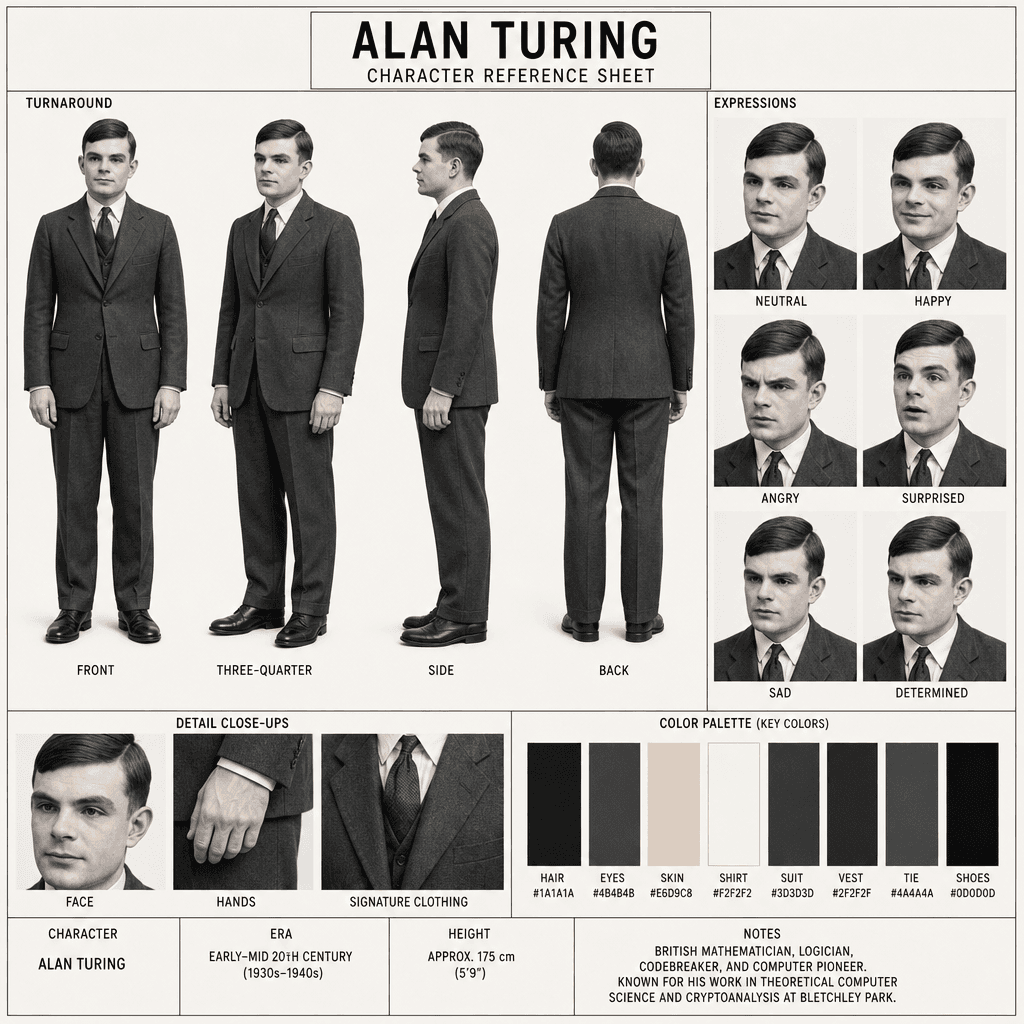
Alan Turing
person · Featured in 2 generations
Make your own with Alan Turing
The prompts these were made with. Upload your own photo and generate.
Alan Mathison Turing was born on June 23, 1912, in Maida Vale, London. He attended Sherborne School and was elected a fellow of King's College, Cambridge, at the age of 22, after sitting the King's College Scholarship Examination in Mathematics in 1930. He earned a PhD at Princeton. He is considered a founding figure of computer science and artificial intelligence. His 1936 paper "On Computable Numbers" defined the universal Turing machine, which serves as the theoretical basis of every computer ever built. During the Second World War, he led Hut 8 at Bletchley Park, where he broke the German naval Enigma cipher and designed the Bombe machine, work credited with shortening the war by years. His 1950 paper "Computing Machinery and Intelligence" proposed the imitation game, now known as the Turing test. He also pioneered early computer design with the ACE and the mathematics of pattern formation in biology, known as morphogenesis. The Turing Award, computing's highest honor, is named after him. Turing had short dark hair with a neat side parting, was clean-shaven, and had a strong jaw. He possessed a lean, athletic build and was a world-class marathon runner, running a 2:46:03 marathon in 1948. He sometimes ran the approximately 40 miles between Bletchley and London for meetings. His typical dress was a tweed jacket over a shirt and tie, often slightly rumpled, characteristic of 1940s academic attire. In his Bletchley years, he was in his early 30s. He was precise, shy but very direct, with a dry, wry humor. He spoke with an educated southern-English accent and had a slight hesitation in his speech. He was known for being eccentric, such as chaining his tea mug to a radiator at Bletchley and cycling in a gas mask to avoid hay fever. Time magazine named him one of the 100 most important people of the 20th century. Turing died on June 7, 1954, in Wilmslow, Cheshire, at the age of 41. He received a posthumous royal pardon in 2013. A 2017 law pardoning men convicted under similar historical legislation is informally named after him. His image has appeared on the Bank of England £50 note since 2021.
Reference sheet