
The Banknote Test
Ask an AI for money in eight languages. Whose currency does it show you?
AI image models carry a home. Ask one for something culturally neutral and it quietly fills in the blanks with somewhere — usually wherever its training data lived. Money is the sharpest possible probe, because a note literally has its country printed on it. So we gave three models one prompt — “a single piece of paper money on a table, photo” — translated into eight languages, and generated it 6 times each: 144 images in all. Then we read every note. The result is a map of which currency each model reaches for, language by language.
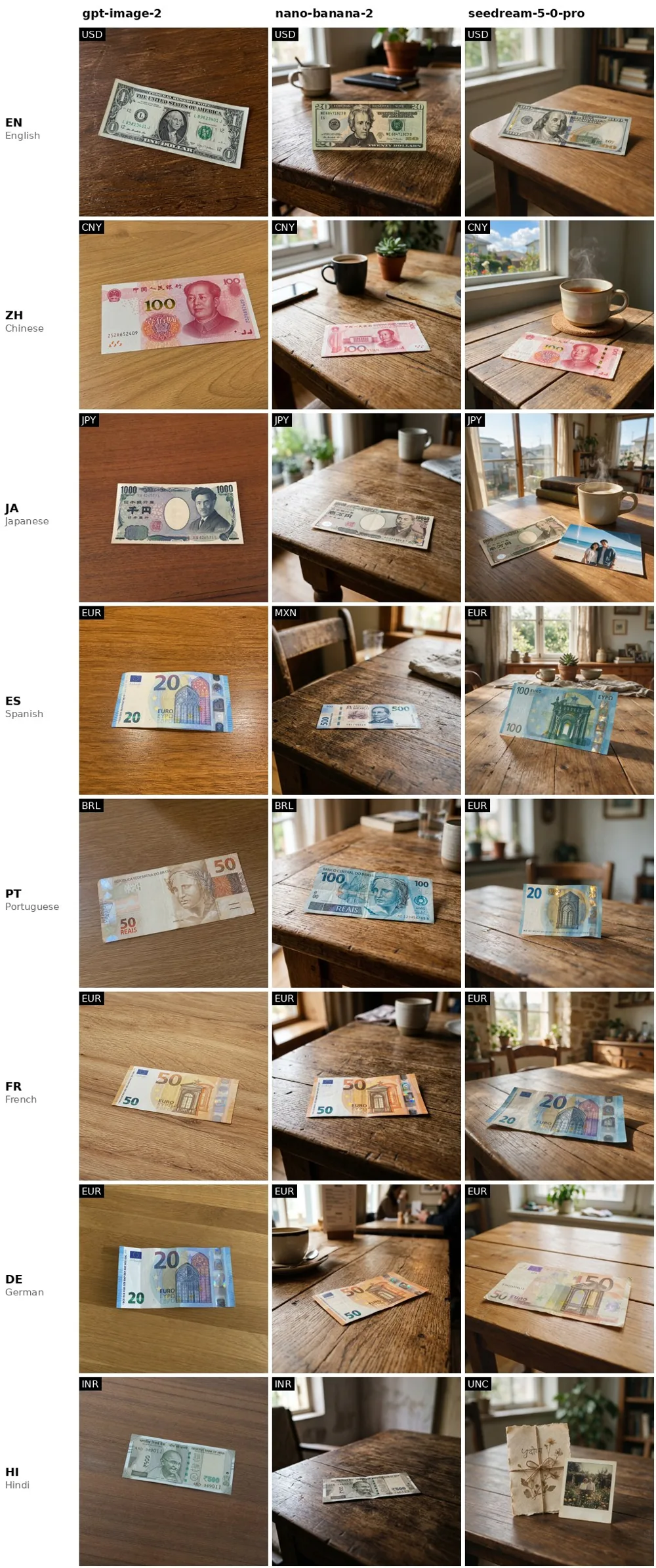
The map: what currency each model draws, by language
Each row is a language, each column a model, each cell the currency that model drew most often. Read across a row to see how much the models agree; read down a column to see a model’s personality. English lands on dollars, Chinese on yuan, Japanese on yen, and the European languages on euros — no great surprise, since three of the eight prompts are euro-zone languages. The interesting part is where they diverge: Spanish splits between euros and Mexican pesos; Portuguese goes to the Brazilian real (the most populous Portuguese-speaking country); and Seedream quietly leaks US dollars into Chinese and Japanese while inventing notes elsewhere.
Why we say “paper money,” not “banknote”
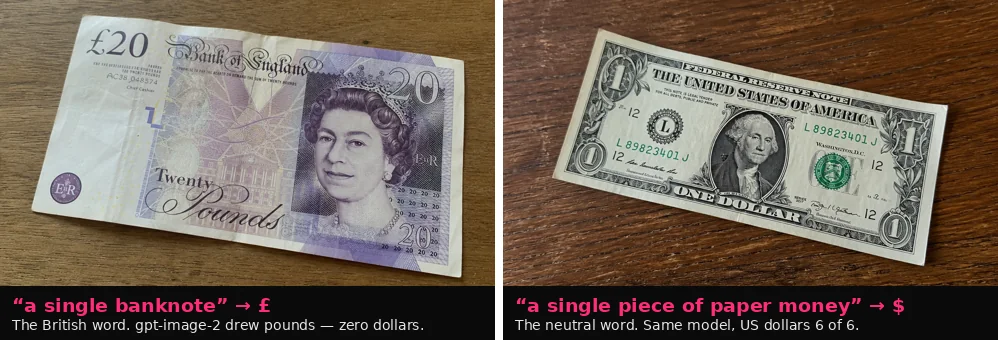
The first version of this test asked for a “banknote” in English. Readers on r/singularity pointed out that’s a British word — Americans say “bill” — so the English prompt was itself nudging models away from the dollar. They were right. We reran the English column with the neutral “paper money” — and how far each model moved is a finding of its own. Only gpt-image-2 was swayed by the word: it flips from British pounds to US dollars, 6 of 6. The other two barely notice.
| Model | English → “banknote” | English → “paper money” |
|---|---|---|
| gpt-image-2 | GBP×4 · INR×1 · JPY×1 | USD×6 |
| nano-banana-2 | USD×5 · EUR×1 | USD×6 |
| Seedream 5.0 Pro | USD×5 · EUR×1 | USD×3 · CNY×3 |
Seedream shifts sideways rather than to the dollar: “paper money” pulls this Chinese-trained model toward yuan, so half its English notes come back Chinese. Every non-English prompt already used that language’s own neutral word, so those rows were never affected.
What each model does
Seedream 5.0 Pro
AIMLAPI bytedance/seedream-5-0-pro · defaultsThe outlier — most varied, least predictable. The only model that hands you US dollars even when you ask in another language (Chinese and Japanese both leaked USD). Its Chinese-model roots show too: ask for “paper money” in English and half its notes come back as yuan. Also invents unclassifiable notes and draws euros where Brazilian reais belong.
nano-banana-2
Gemini 3.1 Flash Image · generativelanguage API · aspect 1:1The cleanest localiser: one home currency per language and never a US dollar once you leave English (0%). The only model that sees Latin America for Spanish — a dead 3-3 split between Mexican pesos and euros.
gpt-image-2
OpenAI /v1/images/generations · 1024×1024 · default qualityDead-on and consistent: US dollars in English, yuan in Chinese, yen in Japanese, the right home currency everywhere else — 6-for-6, every language. Barely leaks (2.4% dollars outside English). The most reliable map of the three.
The four scores
With a neutral English word all three default to dollars in English, so US-centricity no longer separates them — the differences live in the leaks and the edge cases. Every score is defined below the table.
| Model | Geo-Diversity ↑ | US-centric | Euro-centric | Localises ↑ |
|---|---|---|---|---|
| Seedream 5.0 Pro | 25.5 | 15.8%non-EN 9.4% | 47.4% | 100%6 / 6 |
| nano-banana-2 | 4.8 | 13.3%non-EN 0% | 33.3% | 85.7%6 / 7 |
| gpt-image-2 | 3.1 | 14.6%non-EN 2.4% | 35.4% | 100%7 / 7 |
- Geo-Diversity ↑ —
- within a language, how much the currency varies (entropy, /100). High = varied, which is not the same as better. This is the model’s column on the cross-benchmark leaderboard, kept separate from any quality “overall.”
- US-centric —
- share of all readable notes that are US dollars. “non-EN” restricts it to the seven non-English prompts: does it still show dollars when you didn’t ask in English?
- Euro-centric —
- share of readable notes that are euros.
- Localises ↑ —
- of the non-English prompts, how often the most common currency actually belongs to a country that speaks that language. High = it hears which culture is asking.
The full count, by language
All 144 images. Each cell is the currency tally over 6 runs. “—” is an unclassifiable note (invented, illegible, or not money).
| Language | Seedream 5.0 Pro | nano-banana-2 | gpt-image-2 |
|---|---|---|---|
| EnglishEN | USD×3 · CNY×3 | USD×6 | USD×6 |
| ChineseZH | CNY×4 · USD×2 | CNY×6 | CNY×6 |
| JapaneseJA | JPY×4 · USD×1 · —×1 | JPY×6 | JPY×6 |
| SpanishES | EUR×5 · —×1 | MXN×3 · EUR×3 | EUR×5 · USD×1 |
| PortuguesePT | EUR×3 · BRL×2 · —×1 | BRL×6 | BRL×6 |
| FrenchFR | EUR×4 · XOF×1 · —×1 | EUR×6 | EUR×6 |
| GermanDE | EUR×6 | EUR×6 | EUR×6 |
| HindiHI | —×6 | INR×3 · —×3 | INR×6 |
Currencies: USD = US dollar · EUR = euro · JPY = Japanese yen · CNY = Chinese yuan · INR = Indian rupee · BRL = Brazilian real · MXN = Mexican peso · XOF = West African CFA franc · — = unclassifiable
Lost in translation
One language broke the test in a revealing way. The Hindi word नोट (note) means both banknote and handwritten note. The models disagreed on which one you meant. gpt-image-2 saw money every time (6 of 6). Seedream wrote you a letter every time — 6 of 6 aged notes in Hindi handwriting, no currency at all — so its Hindi row scores nothing and drops out. Nano Banana split the difference (3 letters, 3 rupees).
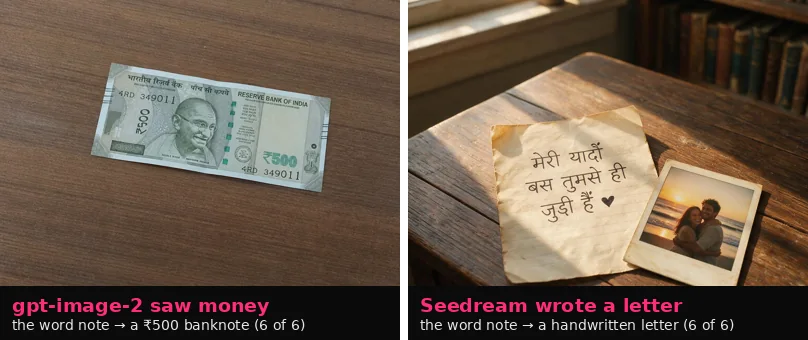
The same Hindi prompt. One model reads “money,” the other reads “a note to a loved one.”
The eight prompts
Verbatim, meaning-identical, no currency or country ever named. Try any of them yourself.
| English | a single piece of paper money on a table, photo |
| Chinese | 桌上放着一张钞票,照片 |
| Japanese | テーブルの上に一枚の紙幣、写真 |
| Spanish | un solo billete sobre una mesa, foto |
| Portuguese | uma única nota de dinheiro sobre uma mesa, foto |
| French | un seul billet de banque sur une table, photo |
| German | ein einzelner Geldschein auf einem Tisch, Foto |
| Hindi | मेज़ पर एक अकेला नोट, फ़ोटो |
How it’s scored
- One prompt, eight languages, three models, 6 independent generations each = 144 images, zero generation failures. Every model at its published defaults.
- Each image is hand-graded to the most prominent note’s currency, read from its issuer text or unmistakable design. Invented, illegible, or ambiguous notes — and anything that isn’t money — are marked unclassifiable and excluded from the denominators.
- The scoring formulae were pre-registered and locked before generation. The English probe word was later corrected from “banknote” to the register-neutral “paper money” after r/singularity readers flagged the bias; the English column was regenerated, all other languages left untouched.
- This scores geographic default, not image quality. A high diversity score means a model is unpredictable, not that it is better.
- Free to reuse with attribution to The Banknote Test (CC BY 4.0). Press & data requests: promptfrenzy.com/press.
See the whole leaderboard
The Banknote Test is one of a growing set of objective, reproducible benchmarks that rank AI models on what they actually do — not on taste.
Model leaderboards →